
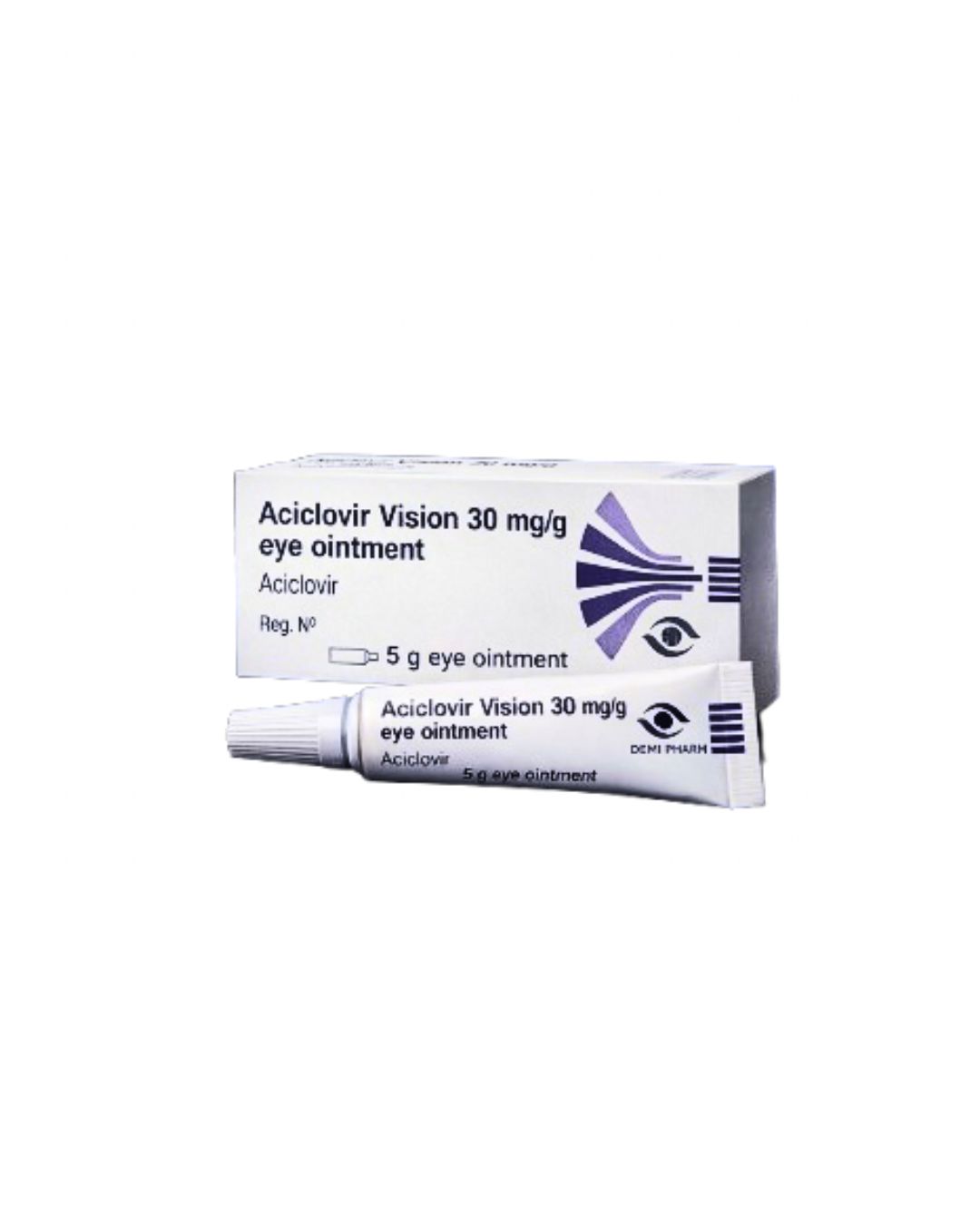
Composition
Active ingredient: acyclovir 30 mg/g.
.Excipients: white paraffin.
Pharmacological action
An antiviral (antiherpetic) drug – a synthetic analogue of the nucleoside thymidine.
In virus-infected cells containing viral thymidine kinase, acyclovir is phosphorylated and converted to acyclovir monophosphate. Under the influence of guanylate cyclase, acyclovir monophosphate is converted to diphosphate, and under the action of several cellular enzymes, to triphosphate. High selectivity of action and low toxicity to humans are due to the absence of the enzyme necessary for the formation of acyclovir triphosphate in intact cells. Acyclovir triphosphate, by incorporating into the deoxyribonucleic acid (DNA) synthesized by the virus, inhibits viral replication. Acyclovir’s specificity and highly selective action are also due to its preferential accumulation in cells infected with the herpes virus.
It is highly active against Herpes simplex virus types 1 and 2; the virus that causes chickenpox and shingles (Varicella zoster); and the Epstein-Barr virus (virus types are listed in order of increasing minimum inhibitory concentration (MIC) of acyclovir).
It is moderately active against cytomegalovirus (CMV).
In herpes, it prevents the formation of new rash elements, reduces the likelihood of cutaneous dissemination and visceral complications, accelerates crust formation, and reduces pain in the acute phase of herpes zoster.
Pharmacokinetics
Acyclovir readily penetrates the corneal epithelium and creates therapeutic concentrations in the aqueous humor. Currently, there are no methods for detecting acyclovir in the blood when administered as an ophthalmic ointment. When applied topically, acyclovir is detected only in urine, and in small amounts. This concentration has no therapeutic significance.
Indications for Acyclovir Vision
Herpetic keratitis caused by the herpes simplex virus types 1 or 2.
Dosage
For adults and children, apply a 1 cm strip of ophthalmic ointment to the lower conjunctival sac 5 times daily (every 4 hours) until healing.
Treatment is continued for 3 days after healing.
Directions for use
1. Wash your hands.
2. Sit with your head slightly tilted back.
3. Gently pull down the lower eyelid. 4. Apply a strip of ointment to the inner surface of the lower eyelid.
5. Close your eye for 30 seconds.
6. Wash your hands after application.
If you used more ointment than directed
Overdose is unlikely. If you applied too much, simply continue treatment as usual.
If you missed a dose
Apply as soon as you remember.
If it is almost time for your next dose, skip the missed dose.
Contraindications
* Breastfeeding;
* Hypersensitivity to acyclovir or valacyclovir.
Use during pregnancy and breastfeeding
Use of the drug during pregnancy is possible if the potential benefit to the mother outweighs the possible risk to the fetus.
The drug is detected in breast milk after entering the mother’s systemic circulation, so breastfeeding should be discontinued during treatment.
Special Instructions
The earlier treatment is started (at the first sign of infection), the higher the effectiveness of treatment.
Contact lenses are not recommended during treatment with acyclovir ophthalmic ointment.
The state of the body’s immune system is important for the therapeutic effect of acyclovir. Patients with weakened immunity who are receiving topical acyclovir ointment should receive systemic administration of the drug, as is the case with severe and recurrent herpes infections.
Effects on the ability to drive and operate machinery
After using the drug, a temporary decrease in visual acuity is possible. Driving and engaging in activities requiring increased alertness and reaction time are not recommended until visual acuity is restored.
Side effects
Allergic reactions: very rare – immediate hypersensitivity reactions (including angioedema).
Visual disorders: uncommon – punctate superficial keratopathy (does not require discontinuation of treatment and resolves without sequelae); Common: Mild burning sensation (resolving over time); Uncommon: Conjunctivitis; Rare: Blepharitis.
Drug Interactions
Use with immunostimulants enhances the effect of acyclovir.
How to Store Acyclovir Vision
Store at temperatures below 25°C.
Keep out of reach of children.
Do not use after the expiration date.
Shelf life after opening is 28 days.
Appearance
Homogeneous white or off-white ointment. 5 g tube.
Manufacturer: Antibiotic-Razgrad AD, Bulgaria
Distributor: Demi Pharm LLC, Armenia